It was October when the city felt most like itself.
She had arrived on a Tuesday evening at Benito Juárez International Airport — Terminal 1, Gate 7 — and taken the Metrobús Line 4 inward through the eastern districts, watching the city accumulate outside the window as the bus pushed along Eje Central toward the Centro Histórico. At 2,240 metres, the air was thin enough to notice. Not dramatically so, but present: a small catch at the top of the breath, a reminder that this was a high plateau and that the body would need a day to understand that.
She spent the first morning doing very little. Coffee from a cart on Calle Madero. A slow circuit of the Zócalo, the great square that has been the centre of this city since before the Spanish laid a single stone — since before the Spanish came at all, in fact, since the Zócalo sits above the heart of Tenochtitlán, the Aztec capital that once rose from a lake now long drained. Under the paving stones, archaeologists have found temples. Under the cathedral, built in the sixteenth century on a foundation of dismantled pre-Columbian stonework, they are still finding more. The palimpsest runs deep here.
By the second day she was ready to move. She took Line 1 of the metro westward — the pink line, its carriages packed by mid-morning, its stations marked by pictograms designed in 1969 to help non-readers navigate — and came up at Chapultepec into the clear October light.
The park absorbed her for most of the day. She had planned an hour in the Museo Nacional de Antropología. She stayed for four. The Aztec Sun Stone alone — which is not actually a calendar, she noted, despite what every second tourist says, but a cosmological diagram — occupied her longer than she had expected. In the courtyard, under the famous concrete umbrella held by its single pillar, she ate a tamale from a vendor near the entrance and thought about the civilisation that built Teotihuacán, whose identity archaeologists still cannot agree on.
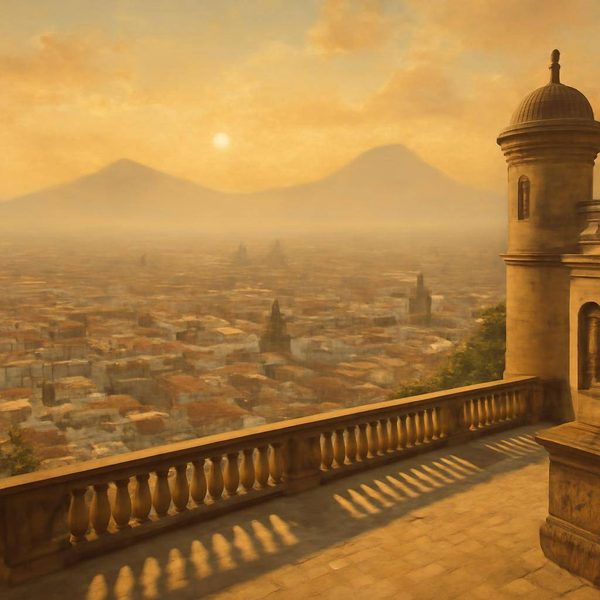
In the afternoon she climbed the hill to Chapultepec Castle. The altitude made the ascent slower than it looked. But the view from the terrace — the city spreading in every direction across the valley, fading into haze where Popocatépetl would be on a clearer day — was worth the breath it cost. This same hill, she remembered, had been an Aztec ceremonial site, then a colonial gunpowder store, then a military academy, then the residence of Emperor Maximilian I in the 1860s, then a presidential palace. It had accumulated roles the way the city itself accumulated centuries.
The third day she went south to Coyoacán.
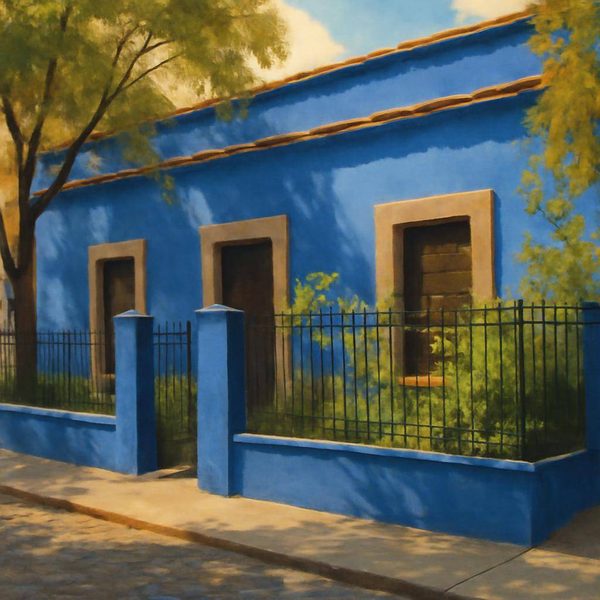
The Casa Azul was exactly as described — cobalt blue walls, a garden, Kahlo's studio preserved with the kind of care that makes absence feel present. The orthopaedic corsets hung on a rack. The pre-Columbian figurines lined the shelves. The mirror above her bed, positioned so she could paint her own reflection while confined there, still caught the light at the same angle it always had. The museum had been Kahlo's home since 1907; it had been a museum since 1958. She had booked her timed entry two weeks in advance. Without it, she would not have got in.
Walking back through Coyoacán toward the metro, she stopped at a market stall selling tacos de guisado. Three tacos, a choice of fillings from seven or eight options kept warm in clay pots, eaten standing at a counter. October in Mexico City smelled of wet stone and maize and the copal incense already beginning to appear in shop windows ahead of Día de Muertos. The city was preparing, as it does every year, to make its peace with the dead.
She thought she might come back in November to see it.
Frequently Asked Questions
What practical route does this Mexico City story follow?
It follows source-backed places and route anchors from the guide, giving orientation and atmosphere while leaving live transport and opening details to the linked sources.
Which live details should I check before using this Mexico City route?
Check current transport, access, opening and weather information from the linked official or operator sources before travelling.
What does this route help visitors understand about Mexico City?
It turns source-backed places, route anchors and local context into a readable visitor route, so the story supports the main guide rather than replacing practical planning.
This is a fictional visitor story generated from source-backed place facts, image evidence and visitor-feel signals. It is not a first-hand WorldTownGuide visit. Named places, routes and historical references are source-backed; the visitor character and narrative events are invented.
Sources: National Museum of Anthropology (Mexico) - Wikipedia • Frida Kahlo Museum - Wikipedia • Metrobus Line 4 Airport Connection - AICM Official • Chapultepec Castle and the National History Museum - Mexico City Official • Using the Mexico City Metro - CDMX Official • Museo Frida Kahlo - Official Site